
By A. O. Okungbowa, Esq.
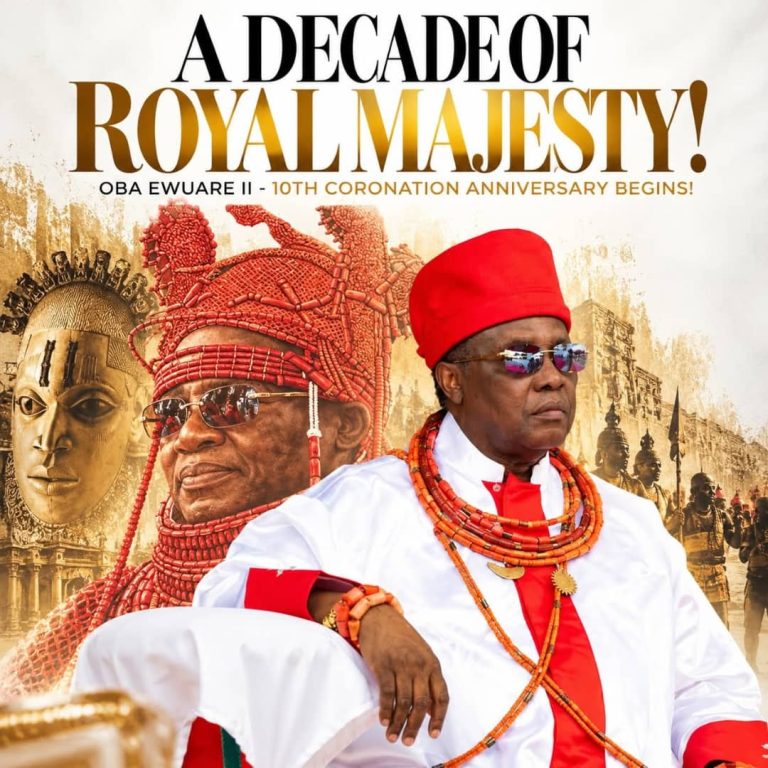
This October, the Benin Kingdom commemorates the 10th coronation anniversary of His Royal Majesty, Omo N’ Oba N’ Edo, Uku Akpolokpolo, Oba Ewuare II, Ogidigan. His ascension to the ancient throne on October 20, 2016, as the 40th Oba in a dynastic succession that predates colonial historiography, was more than a ritual of succession. It was an ontological reaffirmation of a people whose identity is inseparable from monarchy.
In contemporary discourse on Nigerian nationhood, identity is often framed as a contest between tradition and modernity. The Benin experience refutes this binary. The institution of the Oba remains the central organizing principle of Edo identity.
I.The Throne as an Archive of Identity:
European visitors in the 15th and 16th centuries documented Benin City as a marvel of urban planning, with its massive earthworks — the Iya — regarded as the largest man-made earth structure in pre-colonial Africa. The famed Benin Bronzes were not mere decorative objects; they were historical records, legal codes, and spiritual iconography.
The Oba is the custodian of this archive. He is the embodiment of Edo as a civilization. The linguistic, spiritual, and aesthetic norms of the people — from the esoteric language of the palace chiefs (Iwebo, Iweguae, Ibiwe) to the cycle of royal festivals such as Ugie Erha Oba, Igue, and Emobo — derive legitimacy and continuity from the throne. To remove the Oba from Benin history is to render Benin history unintelligible.
II.Ten Years of Ewuare II: Reconciliation, Restitution and Moral Authority
A critical assessment of the last decade reveals three defining pillars of the reign of Oba Ewuare II.
a) Reconciliation as Statecraft: One of the earliest acts of Oba Ewuare II was the political reconciliation of Edo State’s fractious political class in 2016. This act recalled the traditional role of the Oba as the source of peace — a supra-political father figure whose authority transcends partisan contestation.
b) The Restitution Movement: Perhaps the most globally significant contribution of this reign has been the systematic international advocacy for the repatriation of Benin artefacts looted during the punitive expedition of 1897. His Majesty’s intervention elevated the discourse from museum acquisitions to a question of international justice and cultural restitution. The recent returns from Cambridge University, the Smithsonian, and the German government must be understood within this sustained royal diplomacy.
c) Moral Governance: In 2018, His Majesty took the unprecedented step of invoking spiritual sanctions against human trafficking syndicates who exploited Edo youth. By revoking oaths sworn by victims, the Oba demonstrated the potent intersection of traditional spiritual authority and contemporary human rights advocacy.
III. Respect for the Throne is Respect for Our Heritage
At this historic juncture, it is imperative to make a solemn appeal to all Edo sons and daughters, at home and in the diaspora: let us continue to accord the institution of the Oba of Benin the profound respect it deserves.
This respect must not be mistaken for mere protocol or nostalgia. Respect for the institution of the Oba is respect for the Benin cultural heritage itself. The throne is the vessel that has carried our history, our values, our arts, our language, our laws, and our worldview across centuries of disruption, colonization, and globalization.
When we stand when the Oba speaks, when we defer to palace protocol, when we defend the throne against ridicule and trivialization on social media and in contemporary discourse, we are not merely honouring an individual. We are protecting the integrity of a civilization. To desecrate or diminish the institution is to diminish ourselves, for without the Oba, we risk becoming a people with a history but without an anchor, a people with artefacts but without meaning.
Therefore, let this 10th anniversary rekindle in every Edo person an unwavering commitment to uphold the dignity, sanctity and reverence of the throne of our fathers.
IV. The Monarchy and the Nigerian State
Traditional institutions in Africa are not vestiges of a disappearing past but resilient centres of legitimacy. In a multi-ethnic federation struggling with identity cohesion, the Benin monarchy provides a model of cultural stability that supports, rather than subverts, the modern state. It provides psychological security and a sense of belonging that bureaucratic structures cannot.
Identity as Responsibility
The 10th anniversary, therefore, is not merely a celebration of longevity; it is a call to cultural responsibility. The imperative for the Edo person in this second decade of Oba Ewuare II’s reign is to translate reverence into practice: to ensure intergenerational transmission of the Edo language, to support the preservation of tangible and intangible heritage, and to live by the values of Ovbiore — truth, justice and righteousness — that the throne symbolizes.
Oba gha to kpere, Ise!
A. O. Okungbowa, Esq. Ph.D (Constitutional Law) MBA (Artificial Intelligence) is the
Head of Service, Edo State.