
By Simeon OSAJIE
A new historical work, “The History of An African Community (Ikhonmioto): The History of Onicha-Olona Kingdom”, has revived debate over the origins, kingship structure and succession crisis of Onicha-Olona in Delta State, tracing the community’s roots to the ancient Benin Empire and calling for the restoration of what it describes as the rightful royal lineage.
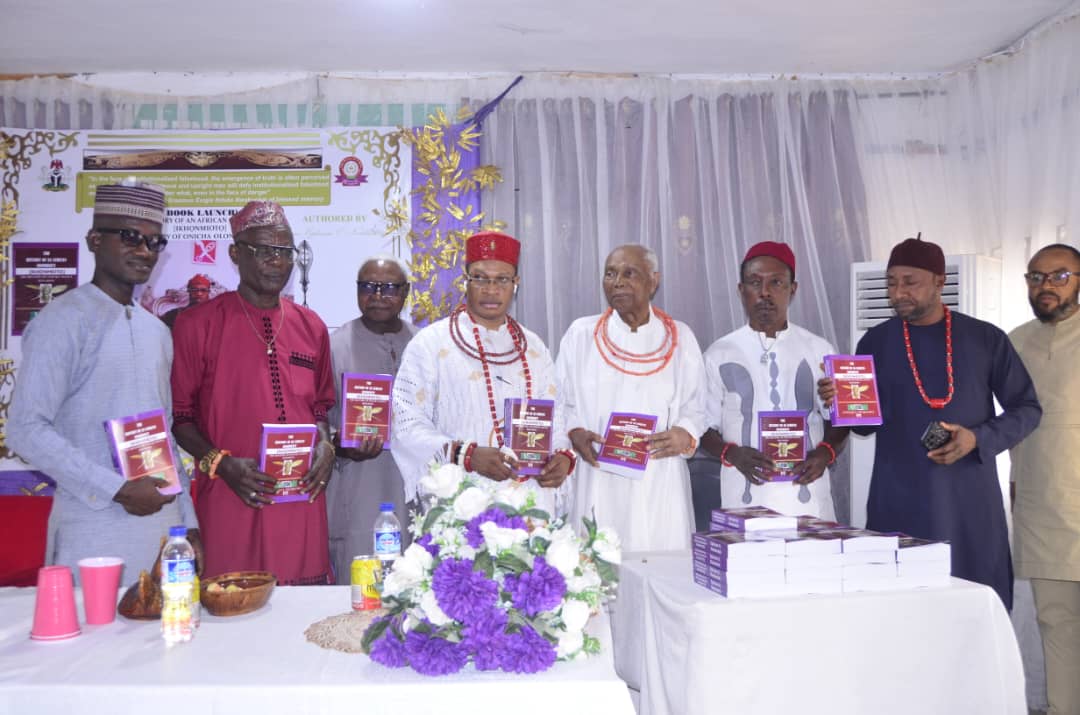
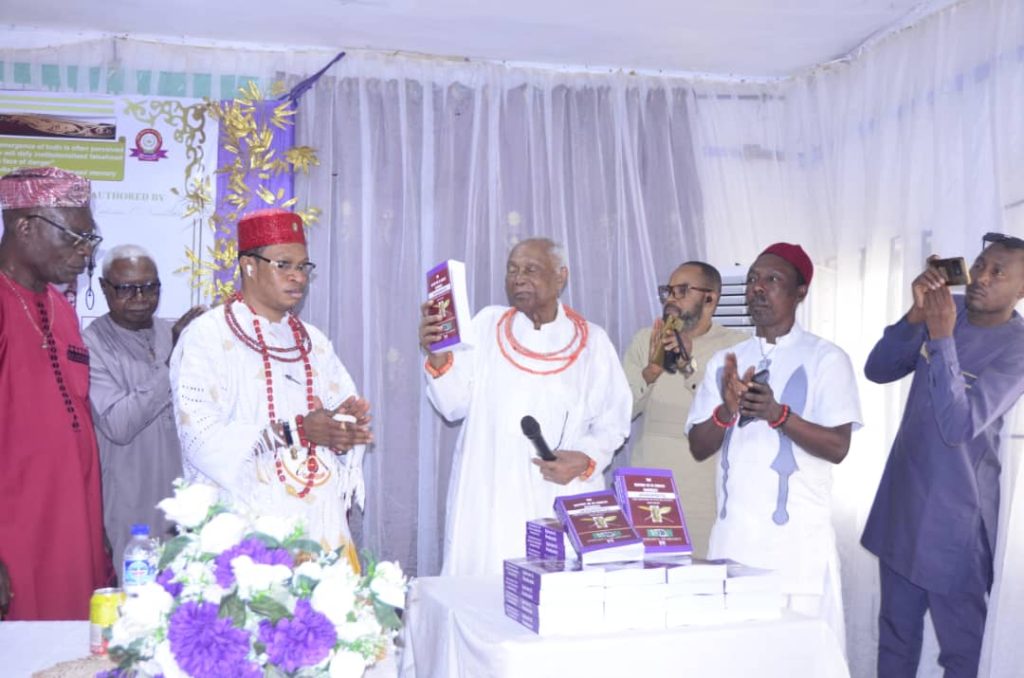
The 545-page book, authored by Prince Engr. Ephraim Odiakaosa Nwabuokei, was unveiled in Benin, Edo State capital by the Iyase of Benin Kingdom, Chief Sam Igbe.
Speaking at the launch, Chief Igbe commended the author for documenting the history of his people and urged the public to engage with the work, describing it as a valuable contribution to the preservation of indigenous history.
Prince Nwabuokei said the book was written to expose “hidden truths” about Onicha-Olona’s past, lamenting that the absence of documented history had allowed distorted narratives to thrive over the years.
According to him, the work seeks to reclaim lost history and restore historical accuracy.
The book was reviewed by sociologist and public affairs analyst, Tony Abolo, who said the book goes beyond conventional storytelling to interrogate the causes and consequences of disruptions in the Onicha-Olona monarchy since the early 20th century.
He noted that the book establishes Onicha-Olona, also known by its ancient names Ikhonmioto or Okhonmina as an offshoot of the Benin Empire, citing political, cultural and administrative similarities with old Benin.
Abolo explained that the author traces the disruption of royal succession to British colonial intervention during and after the Ekumeku War, when traditional authority weakened and warrant chiefs, referred to as “Obis,” replaced the original Benin-style Obaship.
“The book is essentially about setting the record straight,” Abolo said.
“It argues that the House of Ugbe, descended from Benin royalty, was unjustly displaced from the throne around 1900, and that the distortion of succession has continued to undermine peace and development in Onicha-Olona.”
Drawing parallels with Benin history, the book reviewer noted that while Benin restored its monarchy after colonial disruption from the Oba Ovoranmwen to the present Oba Ewuare II, Onicha-Olona has remained trapped in a succession crisis for over a century.
The book chronicles the establishment of the Ikhonmioto Kingdom around 1550, linked to migrations and military expeditions during the reign of Oba Ewuare I and his successors.
It documents traditional institutions mirroring those of Benin, including hereditary succession and palace offices such as the Omu and Odionwere, and details reigns up to Oba Okpoko (1845–1900), whose death coincided with British intrusion.
It also examines the controversial regency that followed, the emergence of warrant chiefs, and an alleged curse pronounced by Prince Chika, the rightful heir denied the throne, an episode the author links to subsequent instability.
Beyond Onicha-Olona, the book situates the community within the wider Benin diaspora, drawing connections to Ubulu-Uku, Ogwashi-Uku, Issele-Uku, Ibusa and Onitsha, and contributing to limited written scholarship on Benin imperial expansion.
Abolo said the book, the third in a series with a fourth volume anticipated, fills gaps left by reliance on oral history through documented references and genealogies.
Available in print and digital formats, including on Amazon, he recommended it to historians, sociologists and Anioma indigenes, urging stakeholders and the Delta State Government to engage its findings in resolving the long-standing kingship dispute in Onicha-Olona.