
There are moments in a nation’s life when words shock more than bullets. Not because they are violent, but because they are absurd, disconnected and offensive to reality.
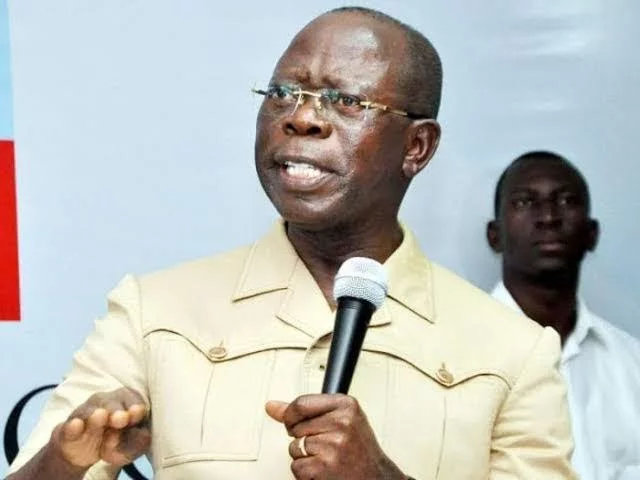
When Senator Adams Oshiomhole recently went on national television and declared that Nigerians are now complaining that food is becoming too cheap under President Bola Tinubu, the country did not just hear a statement; it witnessed a rupture in memory, history, and identity.
This was not said by a random politician, or by an out-of-touch technocrat. This was said by Adams Oshiomhole, the one we once knew as the fiery labour leader, street-fighter for the masses; the man who once stood toe-to-toe with power on behalf of the oppressed. And that is what makes it painful.
There was a time when Adams Oshiomhole’s name was synonymous with resistance, courage and labour struggle. He was the voice of the voiceless. He was the man who confronted government with data, with facts, with moral authority. He was a man who spoke the language of the streets because he came from the streets.
This was a man who understood hunger. Who understood inflation. Who understood the cost of survival. So when that same man now looks Nigerians in the face and says food is becoming too cheap, something deeper than politics has gone wrong.
It would be understandable, though still unforgivable, if our distinguished senator now suffers a selective amnesia where facts and data should live. So, let’s help his memory:
In 2022, on a minimum wage of ₦33,000, a Nigerian worker could buy three bags of rice, sometimes even four. Today, with ₦70,000, that same worker struggles to buy one bag of good rice.
In 2022, a full tank of fuel for some cars cost about ₦22,000. Today, an entire minimum wage can’t fill that same tank.A 350g box of cornflakes rose from around ₦600 to ₦3,500 in the same period, while a 900g loaf of bread moved from ₦600 to ₦2,000. A crate of eggs climbed from ₦600 to ₦6,000. These are just scattered samples from a marketplace drowning in inflation.
One then wonders how a man once defined by data and discipline now finds it so convenient to falsify reality on the altar of partisan exuberance, trading truth for loyalty, and conscience for convenience.
So when anyone, especially Adams Oshiomhole, says food is becoming too cheap in Nigeria, it is not just incorrect. It is insulting.
It is one thing to argue that prices may be stabilizing or slowing down compared to last year. It is another thing to claim that food is now cheap. But to say food is becoming too cheap borders on the ludicrous.
That narrative holds neither on the grounds of optimism nor on any known macroeconomic logic. It is pure fiction.People often think poverty destroys reasoning. But Nigerian politicians are daily proving to us that comfort, power and privilege can do the same.
They are letting us know that proximity to authority can breed psychophancy If a man likes Senator Adams Oshiomole can gleefully tell us that food is becoming too cheap under Tinubu’s administration, it only shows one thing: comfort can detach a person from reality; too much power can erase memory, and tha too much politics can rewrite conscience. And that is exactly what we are witnessing.Let’s just pause for a moment.
Imagine the Adams Oshiomhole of the labour movement era leading a union under the current Tinubu administration.
This country would not know peace. Power would not sleep. Policy would be pressured. That Oshiomhole would have shaken this system so badly the government would either be forced to give or go. But that man is gone. What remains is a politician.
Adams Oshiomhole has every right to defend his party. He has every right to defend his political benefactor. He has every right to defend government policies. That is democracy. That is freedom of speech. That is political alignment. But there is a line. And that line is insulting the intelligence and suffering of Nigerians. Defending policy is one thing; manufacturing fantasy is another.
But, honestly, here’s the truth: The real tragedy is not the statement. The tragedy is what it represents. How politics can change people. How power can rewrite identity. How comfort can erase compassion. How partisanship can silence conscience.
Even a deaf and dumb man on the street knows food is not by any means cheap in Nigeria, in relation to available means. The market woman knows it. The bus driver knows it. The mechanic knows it. The teacher knows it. The student knows it. The unemployed youth knows it. Nigeria knows it.
So when a man who once fought for the masses tells the masses that their suffering is imagination, the betrayal is not political; it is moral.
This is not the Adams Oshiomhole we knew. As Professor Wole Soyinka once implied in another context: The man died. True, the labour leader died. What remains is a politician who speaks not from the streets, but from the comfort of power.
And that, more than anything else, is the real tragedy.
Babs Daramola is a Lagos-based broadcast journalist