
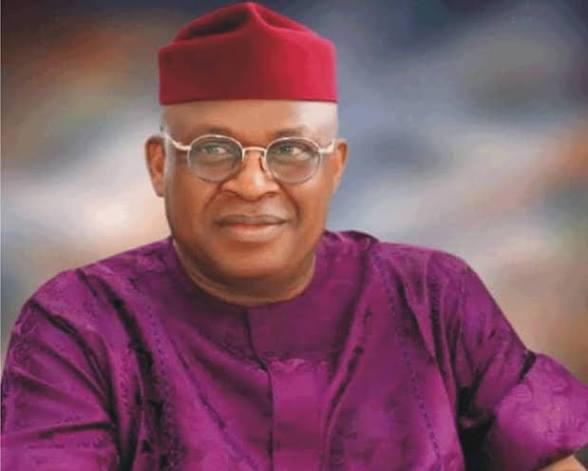
By Senator Odion Ugbesia
The Fleeting Nature of Life
There are moments in life when words seem inadequate to express the depth of one’s grief. The passing of Chief Dan Orbih is one of such moments for me.
Death has a way of reminding us, sometimes painfully, of the fleeting nature of human existence. We live, build relationships, pursue our ambitions, serve our communities and participate in the affairs of our nation, often believing that there will always be another tomorrow. Then, suddenly, someone who has been an important part of our journey is no longer here.
Dan Orbih was not merely someone I knew through politics. Our relationship had a much more interesting and unusual beginning. He was my student at the University of Benin.
I still remember Dan in the classroom—not yet the political figure that the world would later come to know, but a young student among his colleagues, sitting through lectures and engaging with the issues before him. What remains particularly vivid to me is his readiness to participate in discussions. He was not the kind of student who simply sat quietly, absorbed what the lecturer said and waited for the bell. When an issue caught his attention, he wanted to engage with it. He would listen, think about the argument being made and then make his own contribution, sometimes with a confidence that was striking for a young student.
Looking back now, I realise that some of the qualities I later encountered in the politician were already visible in the student. There was an independent mind, a willingness to express a position and, above all, a certain determination not to be a passive observer when he believed an issue deserved his attention.
At the time, of course, I could not have imagined what the future held. I could never have imagined that many years later our paths would cross again in the political arena, and that the student who sat before me in the classroom would become a very good friend, a strong political ally and, ultimately, a brother.
That transformation—from teacher and student to friends and political associates—is one of the most cherished aspects of my relationship with Dan.
Over the years, I came to know him not simply as a politician, but as a man of conviction, loyalty and commitment. In a political environment where relationships can sometimes be dictated by convenience and alliances can be
temporary, Dan stood out to me as a strong, dependable and loyal political ally.
But ours was not a relationship without its storms.
Like most enduring relationships, ours had its difficult moments. Along the way, Dan and I had sharp and, at certain points, seemingly irreconcilable differences. There were disagreements over political choices, strategies and circumstances in which we found ourselves on opposite sides of issues that mattered deeply to both of us.
Those moments were real. They should not be concealed or rewritten simply because death has intervened.
Indeed, perhaps one of the greatest tests of a relationship is not whether disagreements occur, but whether the bond can survive them. Ours did.
There were times when our differences were profound enough to make reconciliation appear difficult, perhaps even impossible. Yet, somehow, the deeper bond that had developed over the years endured. Beneath the disagreements was a history that neither of us could easily erase—a history that began in the classroom and evolved through friendship, political engagement and shared experiences.
Politics can be unforgiving. It can create temporary alliances and equally temporary divisions. People who stand together today may find themselves on opposite sides tomorrow. Political interests change, circumstances change and loyalties are tested.
But some relationships transcend the immediate political contest.
Ours was one of them.
When I entered the 2006/2007 gubernatorial contest, Dan demonstrated his loyalty in a particularly memorable way. He did not merely offer words of encouragement; he committed himself to the struggle. He stood firmly with me, invested his time, energy and resources in the campaign and remained a dependable presence when the political terrain became increasingly difficult.
In Edo North, his support was invaluable. He was a rock and an anchor at a time when the political winds were blowing hard. He took the campaign personally, almost as though his own name were on the ballot. His commitment during that period remains one of the memories of our relationship that I will always cherish.
It therefore came as no surprise to me when he subsequently assumed leadership of the Peoples Democratic Party in Edo State and became an important figure in the political life of the state and the nation. The same qualities of commitment, resilience and loyalty that I had experienced personally were qualities he brought to his political responsibilities.
Our disagreements over the years do not diminish those memories. If anything, they make them more meaningful. A friendship that exists only when two people agree on everything is hardly tested. Ours was tested repeatedly, sometimes severely, and yet it endured.
His passing has therefore left me with a profound sense of loss—not only because Edo State and Nigerian politics have lost an important political figure, but because I have lost a friend whose journey with me began long before politics became the defining context of our relationship.
I remember him first as my student. I remember him subsequently as the man he became: confident, politically active, courageous in his convictions and deeply committed to the causes he believed in. Between those two points lies a remarkable journey, and I feel privileged to have witnessed part of it.
His death also reinforces a lesson that life has taught me repeatedly: positions are temporary, power is temporary and political influence is temporary; but human relationships and the memories we leave behind can endure.
I have seen many people who once appeared indispensable to political movements and governments eventually pass from the scene. The offices they occupied have changed hands. The political structures they helped build have evolved or disappeared. Yet the personal impressions they left on others remain.
That is why I believe that the ultimate measure of a person’s life cannot be found only in the offices he occupied or the political battles he fought. It is also found in the friendships he formed, the people he influenced, the loyalty he demonstrated and the lives he touched.
Dan touched mine in a special way.
He came into my life first as a student, became my friend and political ally, and ultimately became my brother. Even when circumstances drove us apart, something deeper kept drawing us back to the bond we had built over the years.
That is the part of our relationship I choose to remember most.
His death reminds me once again that none of us is here permanently. We are only temporary custodians of our lives, our positions and our responsibilities. We may plan for tomorrow, but tomorrow is never guaranteed.
The appropriate response to the fleeting nature of life is therefore not fear, but gratitude—to appreciate those who have walked with us, to honour those who have contributed to our journey and to ensure that, while we are here, we make our relationships meaningful.
For me, Chief Dan Orbih was one of those people.
I mourn him deeply. I mourn the friend I have lost. I mourn the former student whose journey from the classroom to the political arena I was privileged to witness. And I mourn the dependable political ally whose loyalty and friendship I valued immensely.
But beyond the grief, I choose to remember Dan with gratitude: gratitude for the years we shared, for the friendship that endured despite our disagreements, for the political battles we fought together, and for the remarkable journey that began in a classroom at the University of Benin and continued across many years of public life.
Dan, you came into my life as a student, became my friend and political ally, and ultimately became my brother.
We disagreed. We argued. At times, our differences appeared nearly irreconcilable. But in the final reckoning, those differences could not erase the bond that had been forged over many years.
That is perhaps the most enduring lesson of our relationship: life is too fleeting for us to allow temporary disagreements to erase permanent memories.
I will remember you not only for the political battles we fought, but for the journey we shared, the friendship we built and the loyalty you demonstrated at moments when it mattered most.
May your memory remain a blessing, and may the legacy of your contributions to Edo State and Nigerian politics endure.
Rest in peace, Chief Dan Orbih.
Farewell, my former student.
Farewell, my friend.
Farewell, my ally.
Farewell, my brother.