
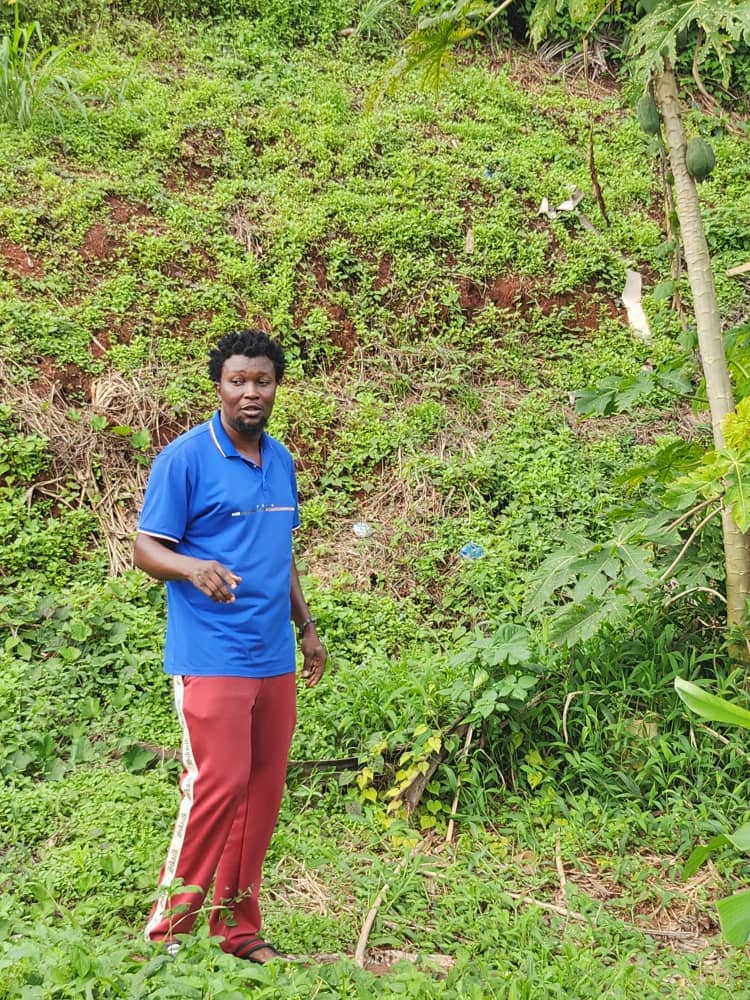
A young scholar was complaining bitterly about the government’s inability to check natural disaster during a recent run of rainfall. And in the midst of the complaint, he cited a case of gully erosion being experienced by some people living at the end of Idia Street, Off Textile Mill Road, Benin City. With great interest I enquired to know about a gully erosion devastating Oliha quarters that I do not know about; only to discover to my greatest amazement that he was actually referring to an ancient Benin moat as gully erosion. The pain of neglect, abandonment, ignorance, loss of identity, waste of source of revenue and regrets encased me, knowing that this present generation are fast being disconnected from our history and where we are coming from as a kingdom. My admiration for these heritage sites is fast being overtaken by a profound sense of regret.
It’s a painful reality to see portions of these historic structures neglected, encroached upon, overgrown or gradually disappearing. Heritage sites that once represented the strength and ingenuity of an ancient civilisation should not be allowed to fade away through neglect. Instead of being turned into education spots, tourist sites, commercial locations and source of revenue, they are recklessly being driven into extinction. Meanwhile, we keep talking about what heritage sites like the Benin moats would have been turned into in other climes.
Will our ancestors ever forgive us? Because, I keep wondering what our ancestors would think of the deplorable and desolate condition of our heritage sites today. It is not out of place to mention the efforts and ingenuity in the ancient civilization. Come to think of it, the Benin Moat, locally known as Iya, is the largest man-made earthwork in the world from the pre-mechanical era. Built in sections over centuries, primarily between the 13th and 15th centuries, with early phases dating back as far as 800 AD. It was later expanded and dug deeper during the reigns of Oba Oguola around 1280 AD and later Oba Ewuare I. Yet the one that beats my imagination is the fact that it was built entirely by hand using simple tools like wooden spades and moving an estimated 37 million metric tons of earth.
No wonder it did not only defined the political, economic, and territorial boundaries of the Benin Empire, but also protected the medieval capital and outlying villages from military invasions, until the British Punitive Expedition of 1897, which burned and looted Benin City, heavily damaging the entire Benin empire. Worse still, rapid urbanization, modern road construction, erosion and regrettably neglect have continued to threaten and shrink what is left of the great Benin heritage like the moats. Would our ancestors really understand why we have allowed such an important part of our history to deteriorate? Would they ask why a heritage that could educate our children, attract visitors and generate economic opportunities has not received the attention it deserves?
I have always said that I am not cut out for passing blames, on whose responsibility it is to do right! But rising could spur someone else; the government or other private institutions. Though I have not had the opportunity of visiting a preserved heritage site like the popular colosseum in Rome, the Rila Monastery of Sofia, Eiffel Tower in Paris, the Acropolis in Athens or the Hagia Sophia of Istanbul, I strongly believe that studying such civilization and painstaking preservation could help us replicate same here. No doubt the government has an important role to play, however, I strongly believe responsibility should not rest with the government alone. We have traditional institutions, cultural organisations, private investors, academic institutions, historians, community leaders and ordinary citizens around these fast fading heritage sites. Why leaving it at the doorstep of the government. With a good proposal and sponsorship backing, no responsible government will turn down a good chance of revitalizing and turning the Benin moats into something more than just monuments of the past. They can become bridges between our history and our future, places of learning, cultural pride, tourism, employment and economic opportunity. Therefore, it is high time we the people of great Benin kingdom start seeing the preservation of the moats as our collective responsibility.
These heritage sites tell us stories without speaking. They are fascinating parts of our heritage, dutifully crafted that once surrounded and protected the great Benin Kingdom. They are not just mere earthworks or remnants of the ancient history; they are living monuments to the intelligence, determination, organisation and engineering skills of the people who built them. Every opportunity to visit or witness these historic moats fills me with a mixture of respect and reflection. Standing beside these moats drifts me into imagining what Benin of centuries ago could be like. The bustling activity within the kingdom, the powerful monarchy, the communities that lived within and around the great defensive earthworks, and the generations of people who contributed their labour to the construction and maintenance.
If properly preserved and developed, these heritage site can help tell the world the story of great Benin kingdom, while still generating sustainable revenue for the communities and institutions entrusted with their care. Our ancestors created us this ancient heritage under crude and sturdy circumstances; hence, I am passionately set out to study and collaborate with well-meaning individuals, corporate bodies and the government to preserve it, revitalise it, commercialize it and then hand it over to the next generation in a condition worthy of the civilisation that created it.
Written by
AIBUEDEFE HUMPHREY USUNOBUN
A Passionate Independent Historian