
By Simeon OSAJIE
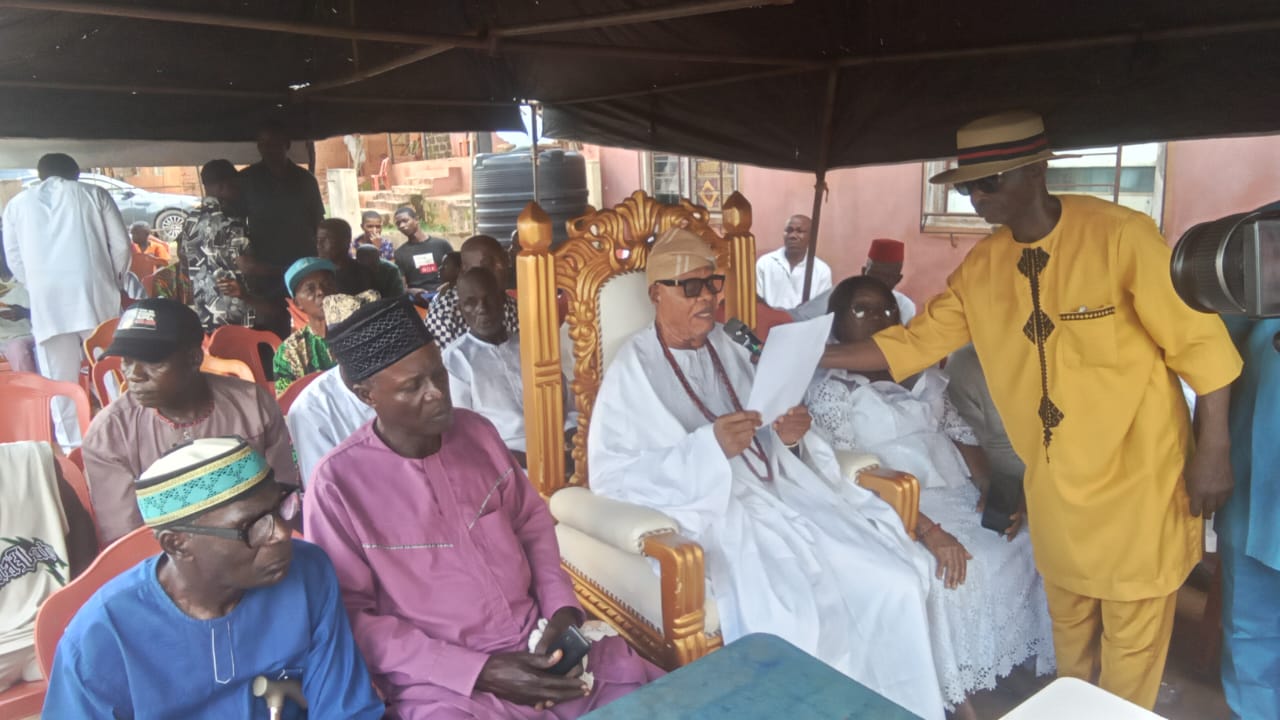
Jubilant scenes played out in Ewu Kingdom on Saturday as thousands of indigenes, friends and well-wishers gathered to celebrate the homecoming of His Royal Highness, Jafaru Isesele I, following the final resolution of the nearly three-decade-old Ewu Kingship dispute by the Supreme Court.
The celebration came on the heels of a series of Supreme Court decisions affirming Jafaru Isesele I as the rightful Onojie of Ewu Kingdom and bringing to an end a legal battle that lasted about 29 years.
In its judgment delivered on July 24, 2024, in Suit No. SC/147/2014, the apex court declared Jafaru Isesele I as the lawful successor to the throne of Onojie of Ewu. The court also issued a perpetual injunction restraining Rasak Yesufu Ogiefo from ever laying claim to the traditional stool.
Subsequent attempts to reopen the matter were unsuccessful. The Supreme Court reaffirmed its earlier judgment, dismissing fresh applications challenging the verdict and awarding costs against the applicants. The court also dismissed an application seeking to nullify its judgment, describing the matter as finally settled.
Addressing the crowd during the victory celebration, the monarch described the occasion as the dawn of a new era for Ewu Kingdom after decades of uncertainty.
“Today marks the culmination of my nearly 30-year journey to the throne of my forefathers,” he said. “This is not merely a celebration of the Supreme Court judgments but the acceptance of a sacred responsibility to unite our people, preserve our heritage, protect our communities and advance the prosperity of Ewu Kingdom.”
The royal father pledged to govern with justice, integrity, fairness, compassion and accountability while promoting inclusiveness across all communities.
“There shall be no room for division, discrimination or exclusion. Our strength lies in our unity, and together we shall build a brighter future,” he declared.
He unveiled what he described as the “New Ewu Agenda,” which will focus on peace, security, reconciliation, youth empowerment, education, healthcare, diaspora engagement and community development.
In an interview shortly after the ceremony, the monarch said the victory celebration was first and foremost an expression of gratitude to God Almighty.
“This battle has been on for 29 years, and we thank God that today we are celebrating victory,” he said.
According to him, the Supreme Court judgments have opened a new chapter in the history of Ewu Kingdom.
“Ewu has been in the dark for almost 29 years. With this judgment, there is a new dawn in Ewu. It is time for reconciliation. I want to bring the whole people together because there is no division. Ewu must unite so there will be peace,” he stated.
He urged all sons and daughters of the kingdom to put the prolonged dispute behind them and work collectively for development.
“It is time for us to move forward. We should fight as one. There should be no division and no exclusion.”
Residents and community leaders who spoke during the event described the Supreme Court victory as a triumph for justice, peace and the preservation of Ewu’s traditional institution.
Pastor Enadame Braimah Godspower from Ukhiodo Community said the celebration marked the end of a legal contest that traversed all levels of the judiciary.
“For the past 29 years, it has been a legal battle from the trial court to the Supreme Court. It is a new dawn for Ewu, a new beginning of progress, unity and peace,” he said.
Similarly, Pastor Braimah Nelson Enakhimion of Ikekogbe Community, Eguare, whose family produced one of the kingmakers involved in the installation of the monarch, described the occasion as historic.
“Justice has finally prevailed,” he said. “This victory is not for His Royal Highness alone but for the entire Ewu people. Without the intervention of the courts, Ewu tradition would have been bastardised. We thank God for preserving the life of the Onojie to witness this day.”
Also speaking, Pastor Matthew Irabor of Uzogholo Community noted that the Supreme Court upheld the long-established customary principle governing succession to the Ewu throne.
He said the apex court relied on the 1979 Bendel State Edict in affirming that succession to the stool of Ewu is by primogeniture rather than selection or election by kingmakers.
Irabor urged all residents to embrace peace and support the monarch in his efforts to move the kingdom forward.
“My advice to Ewu people is to join hands with His Royal Highness Jafaru Isesele I so that development, peace and progress will come to Ewu land,” he said.
The high point of the celebration was special prayers offered by representatives of the seven quarters that make up Ewu Kingdom—Eguare, Ehanlen, Ukhiodo, Idunwele, Eko-Ewu, Uzogholo and Ihenwen – who prayed for lasting peace, unity and prosperity under the reign of the monarch.
The celebration ended with renewed calls for reconciliation, signalling what many residents described as the beginning of a new chapter in the history of Ewu Kingdom after nearly three decades of legal contest.