
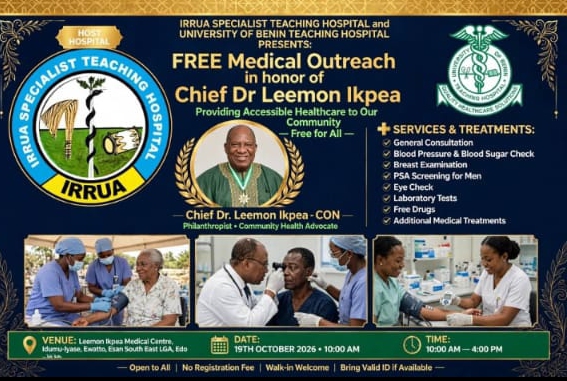
The establishment of a modern 62-bed medical centre in Idumu-Iyase, Ewatto in Esan South-East Local Government Area of Edo State, represents a significant investment in healthcare infrastructure and community development by renowned industrialist and philanthropist, Chief Dr. Leemon Agbonjagwe Ikpea, CON, FNSE.
Built through the Agbonjagwe Leemon Ikpea Foundation (ALIF), the medical facility is designed to improve access to quality healthcare for residents of Ewatto and neighbouring communities, reducing the challenges associated with travelling long distances to obtain medical attention.
The hospital is scheduled to be commissioned on October 19, 2026, by the Coordinating Minister of Health and Social Welfare, Professor Muhammad Ali Pate.
The project reflects Chief Dr. Ikpea’s commitment to addressing critical community needs through private philanthropy, with healthcare identified as a major area requiring sustained investment to improve the wellbeing of the people.
The journey towards the establishment of the medical centre began in August 2024, when Ikpea laid its foundation stone in Ewatto. The initiative was conceived in response to the difficulties residents faced in accessing adequate medical facilities within their immediate environment, particularly when specialised treatment, emergency care and other essential health services were required.
At the foundation-laying ceremony, Chief Leemon asIkpea explained his determination to bring modern healthcare services closer to his people. The project was planned as a 62-bed medical centre equipped with facilities capable of supporting a broad range of medical services.
Since then, the project has progressed from its initial construction phase to a completed and equipped medical complex, marking a significant milestone in the provision of healthcare infrastructure within the community.
The medical centre features male, female and paediatric wards, operating theatres, an accident and emergency unit, labour and postnatal wards, consultants’ offices and administrative facilities. These components are intended to support the treatment of patients across different age groups and medical needs, while providing dedicated spaces for maternity care, surgical procedures and emergency response.
The inclusion of paediatric services is particularly important for children requiring medical attention, while the maternity facilities are designed to support women during childbirth and the postnatal period. The accident and emergency unit is intended to provide a dedicated environment for the assessment and treatment of patients requiring urgent care.
The operating theatres will support surgical procedures, while the centre’s diagnostic facilities, including X-ray and computed tomography scanning equipment, are intended to assist medical professionals in investigating and diagnosing a range of health conditions.
The facility also incorporates physiotherapy services, extending its intended scope beyond immediate treatment to include rehabilitation and recovery. Together, these facilities provide the physical foundation for a medical institution capable of delivering several categories of healthcare services within one complex.
Supporting infrastructure includes standby power supply, ambulances, laundry and restaurant facilities, as well as administrative and other essential service areas. These provisions are intended to support daily hospital operations, patient care and the maintenance of an appropriate clinical environment.
The project also includes doctors’ residences and other supporting facilities, reflecting the importance of creating an environment that can accommodate medical personnel and sustain professional healthcare delivery. The availability of suitable accommodation can be particularly valuable in communities where attracting and retaining qualified healthcare professionals may present challenges.